Proceedings, Tokyo 2015 Workshop on CFD in Ship Hydrodynamics
Abstract:
This paper presents the results of verification and validation (V&V) studies for resistance and self-propulsion simulations together with investigations of the local flow on the JAPAN Bulk Carrier (JBC) with and without an energy saving device (ESD). Computations are reported for all JBC test cases proposed by the Tokyo 2015 Workshop. In total, four V&V studies are presented for Case1.1a, Case1.2a, Case1.5a and Case1.6a using five systematically refined grids in each study. Local flow predictions for Case1.3a, Case1.4a, Case1.7a and Case1.8a are shown using the finest grids of the grid convergence studies. Resistance predictions using the finest grids are within 1% of the measured data both with and without the ESD. The predicted gain in delivered power is the same as in the measurements: 6.0%, although there is an under prediction of the effective wake in both cases
Abstract: Resistance and propulsion predictions for a ship is one of the most important tasks at the design stage in order to ensure that the ship can sail at a desired speed with the installed engine capacity and fulfill the mandatory regulations imposed by IMO such as Energy Efficiency Design Index (EEDI). Since new concerns on environment and efficiency have risen, predictions are getting more important and as a result the interests on Energy Saving Device (ESD) increased significantly. Traditional prediction tools can provide reliable results for resistance and propulsion but it is time-consuming, expensive and most importantly, scaling problems cannot be eliminated. Since Reynolds similarity is not fulfilled at model test, flow characteristics in experiments differ significantly from full scale. On the other hand, Computational Fluid Dynamics (CFD) solves this problem by offering both model and full scale results with a great detail of flow fields. Nevertheless accuracy of CFD is still limited and accuracy obtained from computations is always a concern. In this thesis, resistance, sinkage & trim, self-propulsion characteristics and local flow around the stern are predicted for the new test case JAPAN Bulk Carrier (JBC) for the Japan 2015 Workshop on CFD in Ship Hydrodynamics. Local flow is examined through mean velocity components, turbulent kinetic energy and Q-criterion at the stern region. Also, a comprehensive study is performed for revealing the best settings and procedures for POW tests and self propulsion tests using SHIPFLOW code. Free surface wave elevation, sinkage & trim are computed with the potential flow solver, viscous flow is evaluated by the Reynolds Averaged Navier-Stokes (RANS) solver. Propeller simulation is calculated through lifting line based propeller analysis module (LL) of SHIPFLOW. Additionally, a Verification and Validation (V&V) procedure is applied to the resistance, POW and self-propulsion results in order to assess the uncertainties and numerical errors.
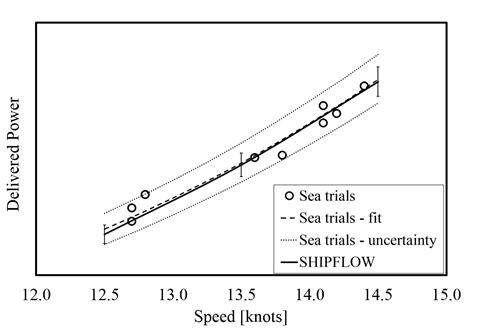
Verification and Validation of CFD simulations of delivered power at full-scale are carried out for a single screw cargo vessel. Numerical simulations are performed with a steady-state RANS method coupled with a body force propeller model based on a lifting line theory. There are no significant differences in the uncertainty levels between model and full-scale computations. The finest grid exhibits the numerical uncertainty of 1.40% at full-scale. Computed results are compared with sea trial data for three sister ships. Special attention is paid to the effect of roughness on the hull and propeller. The comparison error for the delivered power is about 1% which is significantly lower than the experimental uncertainty.
“Improved digital tools for the hydrodynamic design of energy efficient ships – validation, demonstration and introduction to the maritime industry”
FLOWTECH has just successfully finished a project executed with support from the Swedish Energy Agency (Energimyndigheten). The results of the work include the following:
Verification and Validation of CFD simulations of delivered power at full-scale were carried out for ships for which high-quality sea-trial data was collected. Special attention was paid to the effect of roughness on the hull and propeller to improve the accuracy of the simulations. The comparison error for the delivered power was about 1% which shows that the simulations at full scale can very accurately predict power demands of new ships as well as ships in service.
The study performed within this project showed that the numerical optimization of ship hulls at full-scale could yield higher gains in power savings. The presented optimization process included the propeller-hull interactions, and a clear advantage of self-propulsion-based optimization was observed.
An efficient and accurate numerical procedure to estimate the decrease of ship speed in wind and waves was developed. It was used to calculate the weather factor of the attained energy efficiency design index for new ships, EEDI, for a tanker. The predictions were compared to the model test results and a database of similar ships. The comparison error was 1% for the resistance and the predicted weather factor was in line with the database values.
Materials with examples and analyses of the project results illustrating the new possibilities for developing energy-efficient hull shapes were prepared. Several papers for scientific journals were written and the resulst will be presented in the upcoming conferences and workshop on numerical ship hydrodynamics. The results will also be shared with the shipyards and design offices through the company network.